Issue 1
Letter from the Editor:
My dear, sweet readers! I am thrilled to share with you the very first issue of Little Rabbit. Born out of a 450 sq. ft. apartment in Washington, D.C., this magazine is my baby. When I started this project back in December, I had no idea that this first issue would ever even come to fruition. I just knew that I wanted it to, desperately. I love poetry and art and you and my contributors so much. It is with great pride that I share with you… Little Rabbit Issue 1!
-Riley G. Johnston
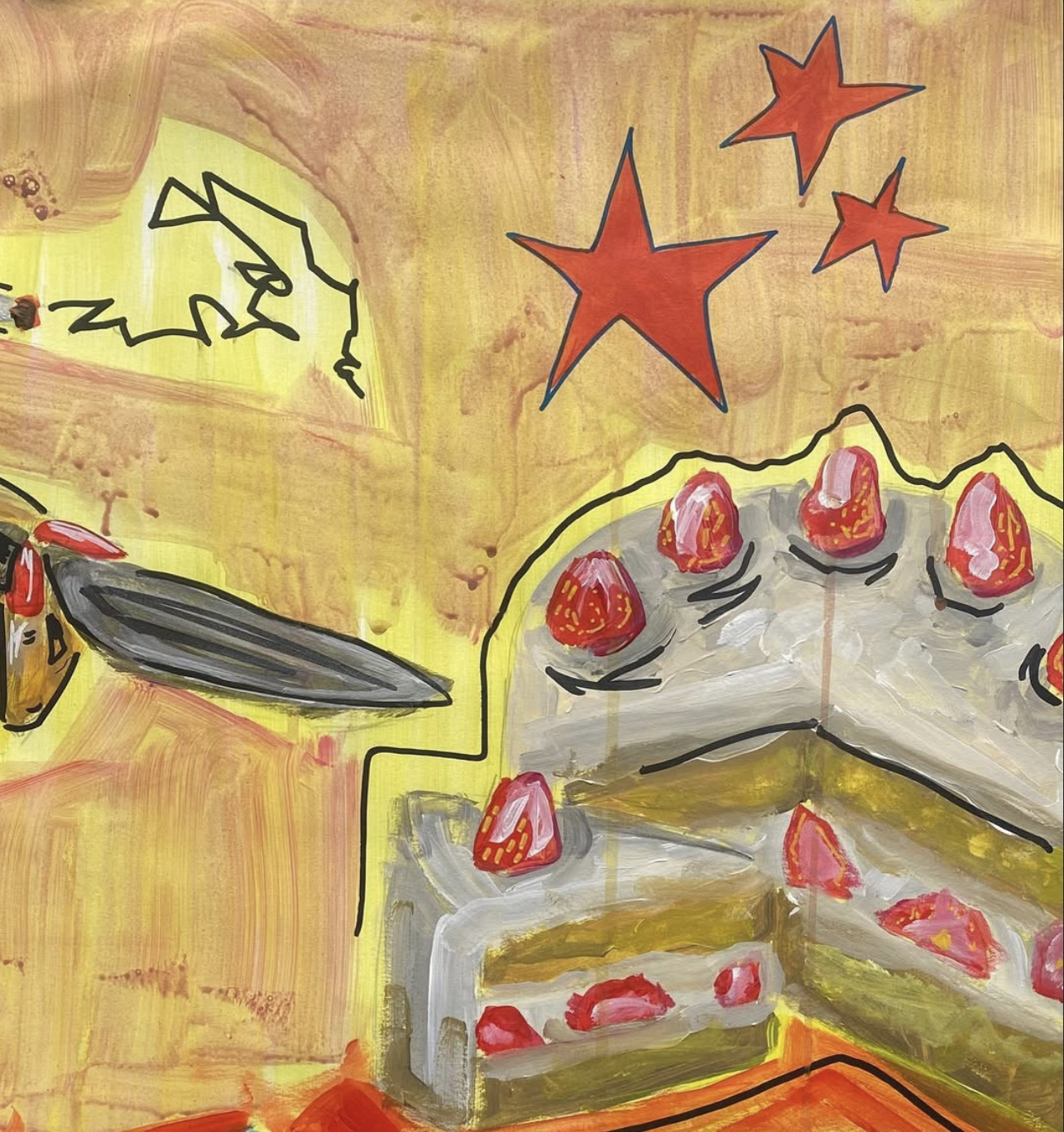
The Birthday Party by Ella Currie
Featured Rabbit
One spot in each Issue of Little Rabbit is reserved for "RMO" (Rabbit Mentions Only)
Cecilia Llompart
One Jackrabbit
And what does the Jackrabbit know of the cold
compress of failure, or the slow faculties of peace?
What interest could it have in the difficult pruning
of boredom—when there is but metaphor to reap
and enjoy. What of the many games we’ve made
of black and of white? And what of stillness—
the inner agency it keeps... Only this perhaps:
That the sky can bomb itself clean of certain blue.
That any animal mistaken for an ass can still make
a name for itself. That every young thing needs
a form of grass to mold with the contours of sleep.
That nothing is too small for the proper burial.
Cecilia Llompart is the author of The Wingless (Carnegie Mellon University Press, 2014). Her book-length poem "Wild Vespers" was a finalist for the Rick Campbell chapbook prize from Anhinga Press in 2020, a semi-finalist for the Black Lawrence Press Chapbook Competition in Fall 2017, and a finalist for the Tomaž Šalamun Prize from Verse Journal in 2016. The recipient of a Poe / Faulkner scholarship at the University of Virginia, she has also been awarded a fellowship from The Dickinson House, and was named one of two finalists for The Field Office Agency’s Postcard Prize in poetry, as well as one of ten winners in Neat Streets Miami “Growing Green Bus Stop” Haiku Contest.
Contributors
( computer viewing recommended )
-
These are a few
The hemlock pressed in the IKEA brochure,
the postcard of a Texaco garage
with its smirking wish-you-were-here,
the short-dated grapes, reduced to clear.
The shower of your smell returns occasionally
and arbitrarily: there will not be a hurricane,
it says, tossing elms. You sparrow in the margins,
your instinctive gliwdream full of needles.
Disorganised Religion
My granddad said
never trust a doctor who believes in god
We were playing with the plastic turtles
in the old tub with feet
The sun was setting
it felt like a good day to bob for apples
The tub was out back with the bikes
and the turtles had wind-up flippers
I thought about taking a bite
out of one of those turtles
Someone in the house said the word microdot
I motioned to the jury of crows
They say unobserved time passes slower
at least that’s something
Brunch Poem #11
In Norway, a man woke
to find the bow of a huge container ship
lodged in his garden
I drink coffee in a room full of dogs
The world is coming down the street
and under the arch
The world is wearing a t-shirt
with a picture of the sun
in sunglasses
In a distant fjord
jets of oil flare
and ice melts into rainbows
The garden stirs with a mechanical buzzing
New apricots palpitate
to the jazz of the morning
Beautiful invasive plants
are tapping at the window
I wake to find a room full of ships
Tom Blake (he/him) is a poet and music journalist from the UK. He has published two chapbooks with The Red Ceilings Press: Ƨ (2023) and Peach Epoch (2025). His work has featured in Streetcake, Anthropocene, And Other Poems, and Perverse. He is a regular contributor of reviews and features to KLOF magazine.
-
Before I Found my Body
I wandered along the production of The Birds:
an extra or a flapping gull, a plot of dehydrated
under-eye, stretched tight from Bodega Bay’s
salt breeze. I was Tippi Hedren’s blowout
tangled before correction, I was stuffed
bird body handled by marionette strings.
What I’m saying is I’ve always been passing
through, that this all seems familiar. I believe
I tumbled from home to home: a holiday hemorrhoid,
a tongue against your tongue, fraying rope
against wrist, until finally, I was deposited
onto my mother’s chest, grape faced, gasping.
Everyone I Love, I Lose to the South
The streetlight against Brian’s balcony railing
drapes shadows that make it look like he’s locked
behind an orange-cast jail. We are sitting in lawn
chairs, drinking homemade margaritas from mugs,
the salt on the rim sliding into the cup when we
make too much movement. He is softest at night and
in Highland Square, the only times I ever see him
blush or succumb to any public gentleness. I secure
my hands to my drink and my gaze to his shadowed,
bar-clad face. This man who sees the world in black
and white, sees daisies as daisies, and potholes as potholes,
no symbols, no allegories, this man who will raise my cut
thumb to his mouth and suck the copper blood gingerly,
who drinks whatever liquor he is served, even if he hates it,
even if it’s Tennessee Honey, drinking with a dignified slurp,
always trying to prove a point that no one will notice.
It’s May and there is still a line forming under the florescent
pink, blinking, “Mary Coyle’s Ice Cream” sign.
I want to stay, I do. But not in this town, my hometown.
It will be years before I hear the phrase,
Everywhere you go, there you are, so for now we exist
in a supercut of 2017, at a crossroads, and I, poised to bolt,
am full of ice-cold fear, on the precipice of falling in love.
In this memory, August is the elephant on the porch.
Everyone I love, I lose to the South, he says. His voice
only this soft when talking to me or praying to God.
Riley Gable-Fleming is a makeup artist from Cleveland, Ohio. She is a Taurus which should not affect your opinion of her unless you like Tauruses. Then by all means. She has been previously published in Rogue Agent Journal, Beyond Words Magazine, HAD, The Rising Phoenix Review, Local Wolves, and more.
-
The New World
More than being Lot’s wife, you learned to
sweat at three months old—no looking back;
no turning back—& you were ready for the
Long Now. Today, I was thinking about you
& how salt burns—bone music for our recently-
dawned, self-salacious century.
I learned the difference between myself &
sweat, & my truest self—which is salt—
brings out the wan fear of this blue pitch—
the slope of a roof rising above a spring
flood—& that nothing ravishing would
ever land on me again, except for a docile
rain that may move in, & after it has fallen,
there would be a whole new world—a
heaven & earth in utter consonance. Pallets
of cacti grow in some new wilderness;
some new adventures in dry earth & a sense
of being; the crossing of a different river.
In the big room where everything is dead or
waiting for the New World to begin, our sun
completes one grand orbit around the heart
of the Milky Way—our home—& our seven
siblings following behind, like sperm in pur-
suit of an egg.
Richard Fox has been a regular contributor of poetry and visual art to online and print literary journals. He is the author of the poetry collection, “Swagger & Remorse.” A former Chicago resident, he now lives in Salt Lake City, UT.
-
I wanted to write a poem about my ex’s new girlfriend’s Instagram account
and looking at your face
I am devastated again in that choiceless
way I crave licking my wounds,
I like the way they taste like iron
like salt like watermelon lip smackers
like your mouth and I know
that I could fall asleep to the sound of your voice
a sound machine of your frantic, seagull musings
you
delighted you and I on the edge of my seat
or is this not a love poem but something ekphrastic
I take you in in a grid, take you in
piece by piece, cheeking you letting you melt there
run beneath my tongue
and just when I swear I’ve had enough
I say I love you
because I know he’ll never tell you
Bleah Patterson is a queer, southern poet from Texas. A current PhD student at the University of North Texas, much of her work explores the contention between identity and home. Her creative and academic work have been supported by organizations like Sundress Academy for the Arts, Vermont Studio Center, Bethany Arts Community, Tin House, and SWWIMM Residency at The Betsy. Her work has also been featured or is forthcoming in various journals including Write or Die, Electric Literature, Pinch, Grist, The Laurel Review, Phoebe Literature, The Rumpus, and Taco Bell Quarterly.
-
, point you toward the entrance of a house or a jagged stone wall.
How close we are. Surfaces. The difference of clocks. Overlay, shoulders, curved in the light. In which blood flows. And from this day, earth. All electrons. I begun my education with redundancies. Pattern recognition, charred residue. Sequels, reboot. Recalculating. Inverted time, a cramped bed for two. My own disruptiveness. Absolute integrity. Words, itch. Noisily. To talk against wishes, false in the mouth. Repetitions. Walk, a bit. The water’s edge. Doomed, to consequence. Into air, this sparkling mist.
Alive is to dead as coupled is to night.
Untethered, distortions. A language for this. Riddle. Even my longest sentence. A date born cold, uncertain. Silence. Reverse order of logic. Burnt out, soaking. To be the other, nothing in one’s hands. In which this text is telling. Transparent, dissected. Foreground. To be tempted. To be tempted to respond. Recall position, shape. Condition, sight. I watch the news. Like anyone. In solitude, disappearance. Abject fear. None of this is new. What words, fail. What words. What wounds. What heart. What speech at all.
Born in Ottawa, Canada’s glorious capital city, rob mclennan currently lives in Ottawa, where he is home full-time with the two wee girls he shares with Christine McNair. The author of some fifty trade books of poetry, fiction and non-fiction, his most recent titles include On Beauty: stories (University of Alberta Press, 2024), the poetry collections the book of sentences (University of Calgary Press, 2025) and edgeless (Caitlin Press, 2026), and the anthology groundworks: the best of the third decade of above/ground press 2013-2023 (Invisible Publishing, 2023). The current Artistic Director of VERSeFest: Ottawa’s International Poetry Festival, he spent the 2007-8 academic year in Edmonton as writer-in-residence at the University of Alberta.
-
What Could Go Wrong
My son & I agree to die
& return as Korean gang
members from the 20th century—
jopok, with black cat
tattoos & that’s how we’ll find
each other. I tell him we cannot
meet as mother & son
in the new life because I won’t
bear his death a second time
or the violence we’ve chosen.
But our pact is essential
to our current lot, both of us
in the streets, with daffodils
pushing up red in the cracks
of alleys, neighbors disappearing
& sunk like cars in a prank
gone bad. There are so many
junk yards at the ocean’s floor,
with the faces of deep-water creatures
resigned & craned up to receive
the heat of our horror, waving
goodbye with fins & smiling
with broken teeth.
Dead President
I like to imagine you
in my kitchen. By you I mean
every person I’ve loved enough
to pin onto my failures. When I explain
a family death
by lightning strike, I liken it
to the shock that traveled
from hot plate to the chopstick
that stirred your mostaccioli
the summer of your bounce house
party. The heat entered
the hand that swaddled the bend
of your elbow & what
patience that elbow, surrendering
to my need. The kitchen reeks
of intimacy, weather
patterns atypical inside my stoic
mouth. I sit on a stool, legs
pinned numb. I could say
Tell me about your day or
Your dismissiveness outweighs
the joy or The President is dead, a shift
that gnaws on day-
old boule, hummingbird sightings,
pots of multiplying suds. You say love
isn’t real but burn your tongue on my soup
spoon as you walk away. I’m left
to eat with my hands alone.
Sara Verstynen is a Chicago-based Korean American poet, essayist, and book reviewer. Her work has appeared in The Margins, Copper Nickel, Reed Magazine, Fugue, and elsewhere. She earned her MFA in creative nonfiction from Northwestern University.
-
8. Organized us
The question riots in the streets:
how does this happen?
little inefficiencies disrupt the
most basic function: the real
problem is
any barrier
to entry looks attractive
from the inside: an entire
neighborhood: small,
organized groups:
those mowed over
by competition think about
the telegraph and the pony
express: chain themselves
to their congressman’s office
door: why?
a ribbon-cutting ceremony
Antistrophe: your tax dollars are in a sandalwood box on the counter. You try to
drive to work but cry at the first song from your high school years. You dream
of the ribbon-cutting ceremony for your high school. Everyone is there: your
teacher, your parents, all of the soldiers bleeding coins, all of the kids with
rocket shrapnel in their skin, your parents, your brother & sister, your kids in
their matching outfits. You approach the ribbon & your father hands you the
giant scissors but he’s crying & he doesn’t want you to take them. Blink 182 is
playing Adam's Song. You take the scissors.
Bill Neumire’s first poetry collection, Estrus, was a semi-finalist for the 42 Miles Press Award, and his second book, #TheNewCrusades, was a finalist for the Barrow Street Prize. His poems have appeared in Harvard Review Online,Beloit Poetry Journal, and West Branch. In addition to writing, he also served as an assistant editor for the literary magazine Verdad and as a reviewer for Vallum.
-
Toothless wonder
Fifteen blades, numb
lip, drooling blood, the
world sitting on itself,
yet to be cracked open,
kneaded like dough
and rising, hungover,
past noon. Do you see
yourself as a part of
everything or everything
as a part of yourself?
You don’t know it but I
am praying for you daily.
I used to be just like
you. Yes, I too, blink and
miss the flash of green
as the sun reaches the
ocean. I, too, possess
an insatiable hunger. I,
too, hear the train
singing before dawn.
This I am
used to- subsisting on
sensation. Going without.
I have had years of practice.
I know when something is
missing. Cracked, unwhole,
my teeth are sitting at the
bottom of a trash can
somewhere.
Lily McKenzie is a Pittsburgh based librarian and poet, having received their MLIS in August. Stemming from Western Maryland where they received their bachelor’s in history, their work is for former tumblr users, recovering theatre kids, and anyone who has ever been victimized by a ouija board at a sleepover. Their work has been published in Garland, where it was recently nominated for Best Small Fiction through Alternating Current Press.
-
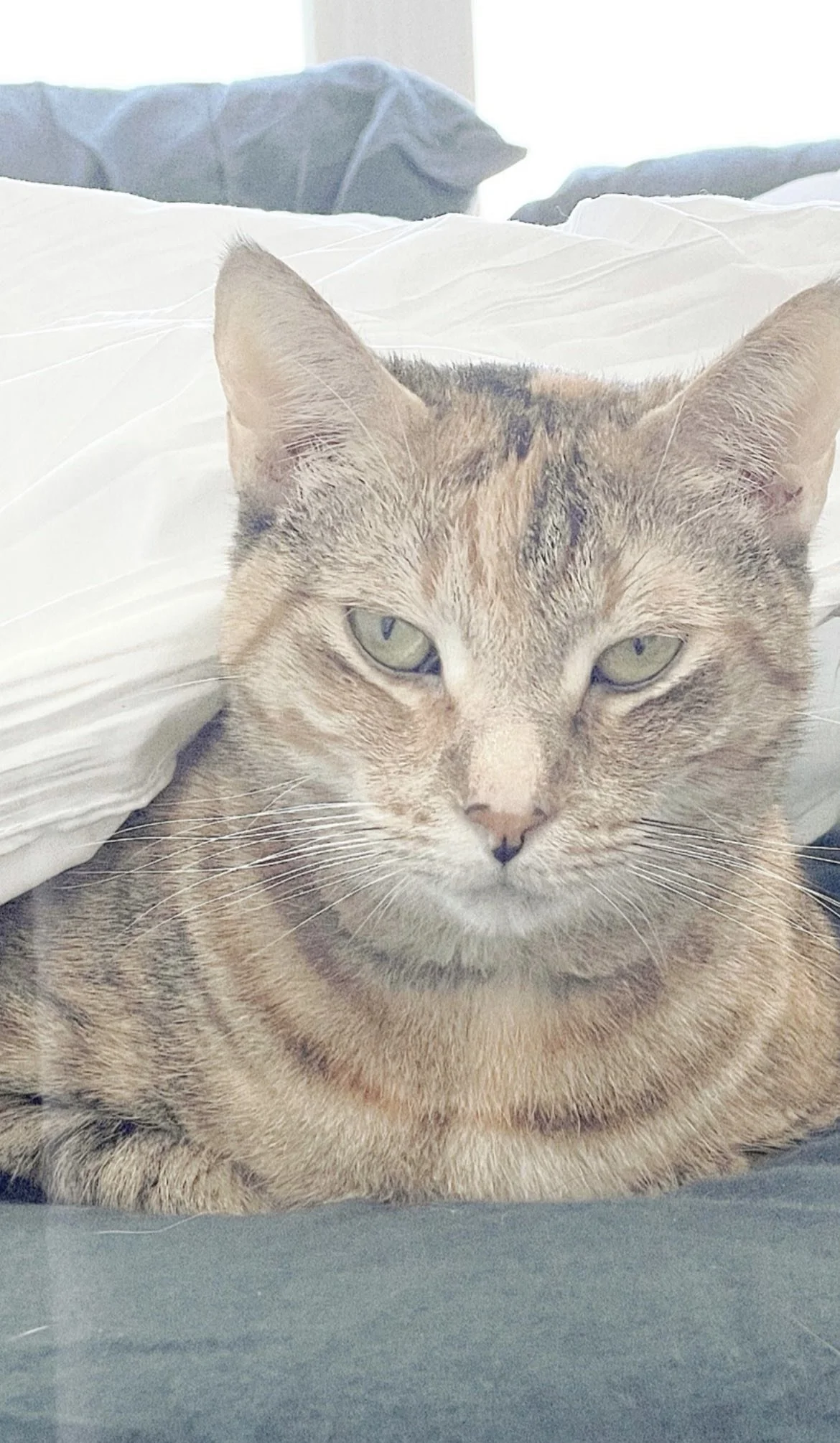
AMBER AND ME
I bring gifts
from the local pet food store:
cat litter, catnip, toys.
Of course, I am not worthy
so I lay them at Amber’s paws.
I am her subject,
provide provisions
for whatever the day may hold.
I let her consider these offerings
in her own quiet, regal way.
Her whiskers twitch as if to acknowledge
the meagerness of my offering,
the largeness of her grace.
I’m just a sucker with a wallet.
Throw in a soft spot for soft, furry faces.
Once I give her what she wants,
she turns away from me.
Her tail flicks. It’s the final insult.
And I stand there in the doorway,
thinking: this is probably the closest
I’ll ever get to being loved.
And still, I wait on her.
What am I but a supplicant,
and in my own house besides.
Her favorite spot is the windowsill.
where she curls up
like a small god sunning herself
in the morning.
In her silence I hear the truth:
love often involves kneeling.
I spend much of the day lowering myself.
John Grey is an Australian poet, US resident, recently published in Midnight Mind, Novus and Calliope. Latest books, Bittersweet, Subject Matters and Between Two Fires are available through Amazon. Work upcoming in Levitate, White Wall Review and Willow Review.
-
In A Dream, My Father Takes Me Fishing
and once our black and blue rods are resting
against the lip of his green jon boat,
fishing lines limp in the lazy current,
he fixes his eyes on the horizon and asks,
Am I a good father?
Do I make you feel loved?
Does any of it make a difference?
We wait for an answer to float into my mouth
as the golden sun melts into the river
and the early waking bats zip and dive
across the slow water, chasing mosquitoes.
I run my tongue against the back of my teeth
like a worm, like bait for this catfish answer
when my line jerks and pulls taut
and we leap into action, reeling and tugging,
but the rod only bends, the line only pulls away.
The sun turns into an inkblot,
black and bleeding,
darkness coming on too fast,
the sky and water mixing.
We clamber over each other’s hands,
awkward and struggling, until the nylon snap
wakes me up, my tongue pinched between my front teeth,
blood seeping into my sleep-dry mouth.
I do not move. I swallow it
and stare at the ceiling,
his questions bobbing through my mind.
I want to reach back into that dreamworld
where my father says what he thinks
or maybe what I wish he thinks
from below a second-hand fishing hat
and smiles at me while I wait to answer.
I want to tell him you could be worse.
I know you’ve done your best.
What can a line do
but break?
Poetry Reading in the Everglades
We stand on the old observation deck,
its white paint peeling off in slivers
which blow in the breeze like the feathers
of the anhinga perched just beside us,
eyes fixed on the impossibly blue water.
The rocking chairs croon and creak.
The sawgrass sways. Kamila tells me
this place looks like one of your poems.
I remember, during childhood river days,
my mom would lose me to the current,
my fingerprints ripples,
my skin pearled surface tension,
my body the arc of a wave.
She used to tell me they must be twins,
what flows between the river beds
and what flows under your skin
and she’d beg me to stop slipping away.
During her reading, Ada Limón says
it is not darkness that unites us,
not the cold distance of space, but
the offering of water, lines from her poem
engraved on the Europa Clipper
launched 1.8 billion miles into the dark.
I think of my love, a thousand miles away,
boarding a plane to visit me and the ponds
where I watch herons stalk and turtles dive,
where I soak in the stanzas of the swamp,
search for the lyrics hidden in the brine.
I worry for him, solid ground fleeting
as the flight soars over open ocean.
He tells me he likes the Atlantic flight path.
He tells me I look out the window
and I see you below, waving.
Cayla Garman is a small-town-Pennsylvania-based writer and a graduate of Penn State Harrisburg. Her work can be found in or is forthcoming at One Art, The Shore, The Milk House, and From the Fallout Shelter.